
George A. Bradshaw: Etchings of Trenton
Introduction
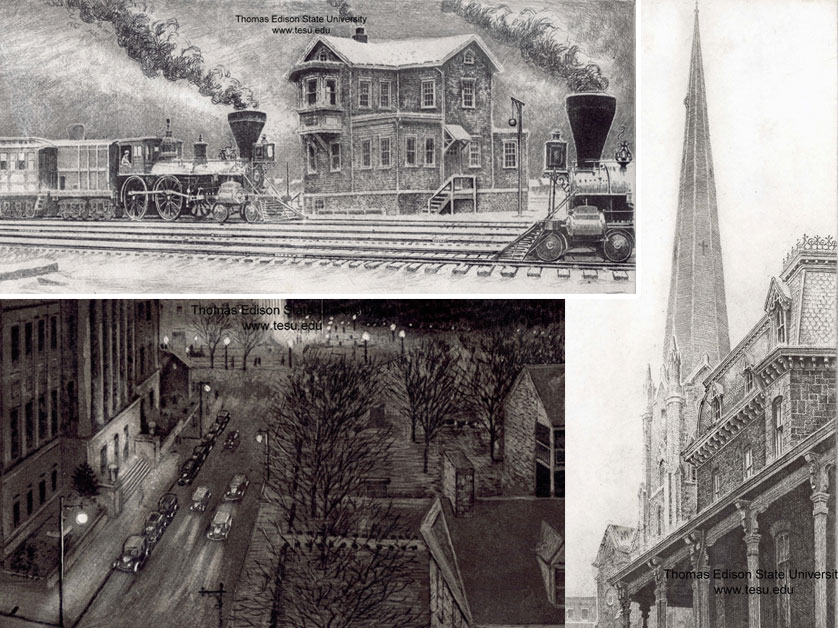
The George A. Bradshaw Trenton Etchings Collection preserves a rare and evocative visual record of Trenton, New Jersey, during a period of profound civic, industrial and social transformation. Comprised of 64 etchings, the collection documents streets, neighborhoods, industrial sites, religious institutions and civic landmarks as they appeared from the late 19th through the mid‑20th centuries.
Through careful observation and precise line work, Bradshaw captured Trenton as a living city shaped by water power, manufacturing, transportation and community life. His etchings provide both artistic interpretation and historical documentation, offering insights into the city’s evolving built environment at a time when many of these scenes were already beginning to disappear.
About the Artist
George A. Bradshaw (1880–1968) was an American artist known for his etchings of urban and industrial landscapes. Based in Trenton for much of his life, Bradshaw developed a sustained interest in recording the city’s streets, waterways and structures. His work reflects a deep familiarity with Trenton’s geography and history, as well as a commitment to preserving visual memory through printmaking.
Bradshaw’s etchings are distinguished by their clarity of composition, architectural precision and attention to place. Rather than idealizing the city, he depicted Trenton as it was — active, utilitarian and shaped by the forces of industry and public life.
The Trenton Etchings
The etchings in this collection depict a wide range of Trenton locations, including:
- Industrial districts and canal systems
- Streets and residential neighborhoods
- Churches, synagogues and meeting houses
- Civic buildings and municipal spaces
- Transportation corridors and riverfront scenes
Collectively, these images trace Trenton’s growth from a canal‑powered industrial city to a modern urban center. Many of the scenes Bradshaw depicted no longer exist in their original form, making the etchings invaluable as historical records as well as works of art.
The Collection at TESU
Thanks to a generous 1986 donation, a collection of 64 of Bradshaw's Trenton-area works is owned by Thomas Edison State University. Raymond L. Steen, the retired president of the Broad Street National Bank, donated the etchings to the University in memory of his wife, Mary McPherson Steen.
The Trenton etchings were created during the years that Bradshaw taught at the Kelsey Building, then part of the School of Industrial Arts. One of his most popular night scenes, "Symphony Night," was sketched from the vantage point of the school’s fifth floor arts studio.
The George A. Bradshaw Trenton Etchings Collection is held by TESU and preserved as part of the University’s commitment to documenting New Jersey history and culture. Each etching has been carefully cataloged and digitized to support public access, teaching and research.
This website presents the collection in an interpretive format designed to complement the authoritative catalog records available through the TESU Vault. Together, these resources allow visitors to explore the collection visually while also engaging with its historical and artistic context.
George A. Bradshaw Trenton Etchings Collection
Courtesy of Thomas Edison State University
Images and interpretive content are provided for educational and research purposes.